
User simulators need a difficulty baseline
In short: MIMESIS shows that fluent AI users can make agent tests easier than real customers, so accept simulators against interaction difficulty, not dialogue quality.
Meta Superintelligence Labs reported on 8 October 2026 that the same GPT-5.5 agent completed 63.6% of tasks with real users but 82.4% to 84.4% when three frontier models played the user. The agent did not improve. Its counterpart became easier.
That is the number I would put at the top of every interactive-agent evaluation. A user simulator should be accepted against the interaction difficulty it reproduces, not how natural its dialogue sounds. If it supplies missing details, follows instructions cleanly and rarely changes its mind, it can certify an agent for a customer who does not exist.
The MIMESIS paper is the strongest recent evidence I have seen for treating the simulated user as part of the benchmark, rather than as neutral test plumbing. Its authors trained 4B- and 9B-parameter simulators around 13 user-behaviour patterns, then evaluated what happened when agents learned from them across eight environments. The useful result is not merely that one simulator won. It is that simulated users changed the apparent difficulty of the same work.
MIMESIS exposes the hidden denominator
Interactive-agent scores are usually presented as though the task and agent determine the result. There is a third term: the policy of the user on the other side. Does the user volunteer a phone number? Resist a suggestion? Ask an underspecified question? Correct the agent after a misunderstanding? Each choice changes the path to success.
In the paper's fixed-agent comparison, frontier assistant models role-playing users were dramatically more cooperative than people. Purpose-built MIMESIS models sat much closer to the real-user baseline.
| User in the interaction | Fixed-agent task success | Difference from real users |
|---|---|---|
| Real users | 63.6% | baseline |
| MIMESIS-4B | 65.5% | +1.9 points |
| MIMESIS-9B | 66.1% | +2.5 points |
| GPT-5.5 | 82.4% | +18.8 points |
| Gemini 3.8 Flash | 82.8% | +19.2 points |
| Claude Opus 5 | 84.4% | +20.8 points |
Author-reported task success from MIMESIS v2; I have not independently reproduced these experiments.
This is not a small calibration miss. A team could believe it has an 84% agent when the comparable real-user number is 64%. More fluent transcripts would make that mistake harder to notice, not safer.
Natural dialogue is the wrong acceptance test
A transcript can sound human while preserving the wrong distribution of difficulty. The simulator may vary its phrasing yet still behave like an unusually patient expert: one request at a time, all required facts available, no contradictory constraints, no abrupt topic changes.
That matters twice. First, evaluation becomes generous. Second, training overfits the agent to cooperative interactions. The MIMESIS project reports that agents trained with its simulator generalized better across nine unseen user simulators than agents trained with a GPT-5.5 user simulator. Mean performance rose from 26.10 to 29.54; a curriculum variant reached 31.09. Those figures are author-reported and the unseen simulators are still models, not a production customer population, but they point in the same direction: the user distribution is part of the training specification.
This sharpens an argument I made about adaptive agent environments. The environment is not only tools, rewards and tasks. In an interactive system, it includes how the other participant withholds information, misunderstands, hesitates and refuses.
How I would accept a user simulator
I have not trained MIMESIS or reproduced its results. What follows is editorial judgement: an operating control I would ask an AI lead to use before a simulator can certify an agent.
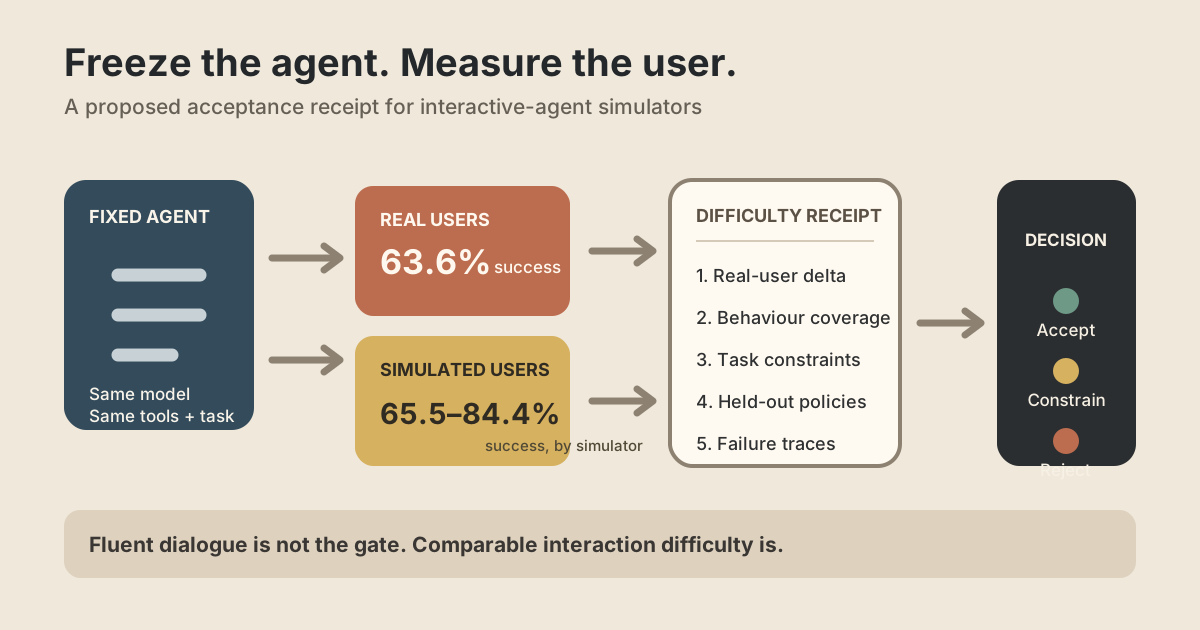
Give the simulator a difficulty receipt. Start with a small, consented real-user set and freeze the agent. Measure the success-rate gap between real and simulated users on the same task family. Then record which behaviour classes the simulator covers, the constraints that stop it from solving the task for the agent, performance under held-out simulators, and representative failure traces.
The receipt is not a demand for perfect imitation. It is a demand to make the distortion visible. A simulator can be useful while differing from real users, provided the team knows where, by how much and with what consequence. The dangerous simulator is the one whose fluency conceals an easier benchmark.
The released MIMESIS code makes the method inspectable, including the data and training pipeline. That is helpful, but it does not answer whether the 13 behaviour patterns cover your enterprise population. Your customers may introduce language mixing, domain-specific misunderstandings, accessibility needs, fraud attempts or organisational policy constraints that are absent from a research corpus.
Where the evidence stops
The paper evaluates eight research environments and reports 2,155 ThoughtTrace conversations for interpretability analysis. It does not establish production customer outcomes, independent replication or transfer to a particular enterprise workflow. Its real-user comparison is valuable precisely because it is limited: it gives a reference point, not universal certification.
The next step for a product team is therefore not to replace one default simulator with another and declare victory. It is to preserve a local real-user baseline, add the difficult behaviours the product actually encounters, and rerun the fixed-agent comparison whenever the simulator changes. Otherwise an apparent agent improvement may be nothing more than a more accommodating fake customer.
What's in it for you
- Freeze the agent and compare simulated-user success with a small real-user baseline before accepting an evaluation suite.
- Require behaviour coverage and failure traces beside any claim that a simulator sounds realistic.
- Re-test held-out user policies after training so gains do not depend on one cooperative counterpart.
The user simulator is part of the product specification: measure the difficulty it creates before you trust the score it produces.
Sources
- MIMESIS: Training and Evaluating Interactive Agents with Purpose-Built User Simulators, v2, 8 October 2026.
- MIMESIS project page, accessed 12 October 2026.
- MIMESIS code repository, accessed 12 October 2026.