
AI research releases need a review budget
In short: OpenAI's 372-family maths release shows why AI research needs a funded review queue, not only public files and version history.
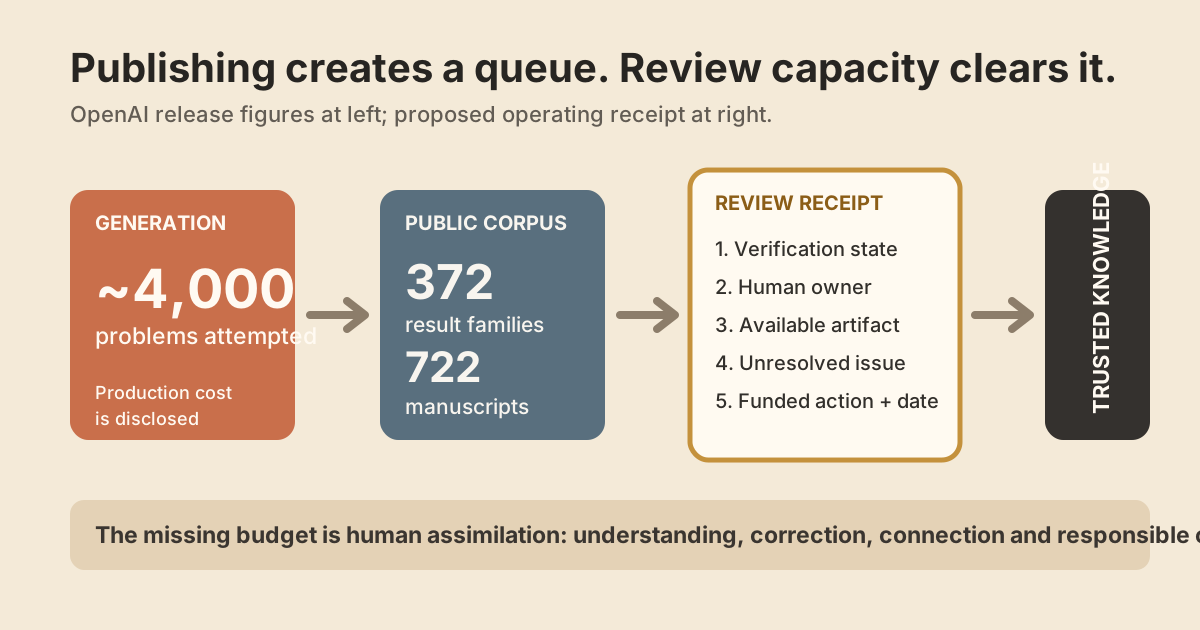
On 6 October 2026, OpenAI released 722 mathematics manuscripts organised into 372 result families. Its repository says the work came from roughly 4,000 attempted problems and averaged about three hours of ChatGPT Pro thinking compute per result.
That is not merely a research release. It is a new kind of review queue. My claim is that AI research releases need a funded review budget for each result family, because public files make claims inspectable but do not allocate the expert attention required to turn them into trusted knowledge.
OpenAI's maths release exposes the verification queue
OpenAI's repository is unusually direct about its boundary. The collection contains work at different verification stages. Not every manuscript has a Lean formalisation, and OpenAI says some unformalised results could contain issues. Corrections will appear as new versions while old versions remain accessible.
| OpenAI's disclosed release measure | Value |
|---|---|
| Problems posed to the model | about 4,000 |
| Result families retained | 372 |
| Manuscripts published | 722 |
| Average compute per result | about 3 Pro thinking hours |
| Reasoning summaries released | 10 |
These are OpenAI's release figures; I did not verify the mathematics or reproduce the internal model runs.
That versioning design is valuable. A reader can cite a specific manuscript, inspect later corrections and, for many results, examine formal proof artifacts. But version control answers what changed. It does not answer who understands the argument, which specialist has challenged it, what remains unresolved or when anybody will return to the queue.
The distinction matters because 722 files can look like 722 completed units. They are not. OpenAI itself groups them into 372 families that may contain a principal result, companion arguments, consequences and alternative proofs. The family is the sensible unit of review, not the PDF count.
AGMAI treats publication as the start of assimilation
The independent Advisory Group on Mathematics and Artificial Intelligence, or AGMAI, reached the same boundary from the community side. Its 29 September recommendations were informed by more than 600 responses. They say labs that release substantial mathematical output without immediate human understanding should support the work needed to develop that understanding, while leaving the direction of that work to the community.
AGMAI asks for scholarly repositories, persistent identifiers, recorded modifications, process metadata and formalisation where possible. It also asks labs to fund workshops, working groups, students, postdocs and exposition in proportion to the importance and complexity of the output.
After OpenAI published the collection, AGMAI's 6 October response made the status plain: making the work public is a first step, not the completion of human understanding or incorporation into mathematical knowledge. Its advisory role is not an endorsement of the results or the process.
OpenAI's own announcement commits to workshops, conferences and special programmes. That is directionally right. What remains invisible is the operating bridge between a large public corpus and those future activities.
My proposed AI research release receipt
This is labelled editorial judgment. I am not a mathematician reviewing these proofs, and I have not deployed this process at Trigent or for a client. I am translating a familiar release-management problem into a research setting.
For each result family, I would publish five fields: current verification state, responsible domain owner, available reproduction or formalisation artifact, most important unresolved issue, and the next funded review action with a date. A family with no human owner should say so. A formalised proof should name what the formalisation covers and what assumptions remain outside it.
This receipt does not pretend that mathematics can be reduced to a ticketing system. It prevents a more ordinary failure: a spectacular release consuming community attention without showing which claims have reviewers, which ones are blocked and which ones have quietly become citation dependencies.
The budget belongs beside the queue. If generation cost is disclosed while understanding cost is not, the release makes production look cheap by exporting the expensive part to universities and individual researchers. That is the original liability created by batch research generation: expert attention becomes an unpriced external dependency.
A review budget is different from proof verification
This argument advances three earlier AndyMental receipts without replacing them. Stage attribution stops a formal verifier from inheriting credit for discovery. An interest gate asks whether a correct result deserves the next experiment. An experiment trace preserves the path that produced a scientific result.
A review budget starts later. It asks whether the public claim has enough human capacity around it to become understood, corrected, connected to prior work and responsibly cited. Lean can check a formal statement against encoded assumptions. It cannot assign scarce mathematicians across 372 families or decide which result should reshape a field.
I would therefore resist both easy readings of this release. The count does not prove that 372 families are correct. Mixed verification status does not prove that they are wrong. The useful fact is that the output rate is now large enough to make review capacity part of the release design.
What's in it for you
- Add owner, state, unresolved issue and next funded action to every batch of AI-generated research or technical proposals.
- Measure the queue by result families and review age, not by files produced.
- Keep generation cost and human-assimilation cost in the same release receipt.
Publishing makes AI research inspectable; a funded review queue is what gives it a path into trusted knowledge.
Sources
- OpenAI — Sharing AI progress in mathematics, 6 October 2026
- OpenAI — math repository, accessed 8 October 2026
- AGMAI — Responsible Release of AI-Generated Mathematics, 29 September 2026
- AGMAI — On OpenAI's Release of Mathematical Results, 6 October 2026