
Agent payments should earn the right to write
Paytm shipped payment visibility while Cloudflare opened wallet handles before spend access. The safer rollout pattern is to observe, rehearse, then grant bounded writes.
Paytm gave Claude access to payment data on August 10. It did not give Claude the ability to move money. Four days earlier, Cloudflare announced wallets for agents, but the thing available that day was a wallet-handle reservation. Full wallet access and Virtual Wallets were still due “in the coming months.”
That gap between the headline and the shipped authority is the useful part. I read these two launches as a permissions sequence: let the agent see, then let it propose, and only then let it spend inside a box. Read-only is not a weak version of an agent-payment product. It is the first rung of the product.
Paytm shipped eyes, not hands
Paytm’s Claude MCP connector exposes transactions, payment links, refunds, settlements, subscriptions, order status and reconciliation details through authorised prompts. Finance and support teams can ask about the state of money without hopping through dashboard pages.
The boundary is explicit. Payment execution, refunds and settlement remain in merchant-controlled processes on Paytm’s infrastructure. Paytm says the connector reduces manual work and speeds access; I have not tested those product claims, and the announcement reports no measured before-and-after result.
Still, the boundary itself is real. An agent can answer “where is this refund?” without gaining the ability to issue one. That is useful production capability, not a demo with the interesting button disabled.
I argued earlier that agents make reads cheap while governed writes remain valuable. Payments turn that distinction from a product strategy into an operating rule. A wrong read wastes time. A wrong write can create a second refund, send money to the wrong party or leave finance reconciling an action nobody can explain.
Cloudflare designed the box before opening it
Cloudflare’s August 4 Wallets announcement sounds further along: a central Account Wallet for a human or organisation, then Virtual Wallets that individual agents can use. The proposed controls are concrete—spending cap, approved merchant list and maximum transaction size. Cloudflare’s technical post also describes manual overrides and review when spending becomes anomalous.
But on announcement day, only handle reservation opened. Cloudflare said wallet funding, withdrawals and Virtual Wallet issuance would arrive later. So the spend architecture was public before the spend authority was available.
I do not know whether that order came from regulation, product readiness, risk review or simple launch sequencing; neither source establishes the cause. My narrower bet is about how teams should adopt it: keep the same order even after the vendor makes the final API available. Availability is not evidence that your agent has earned access.
Promotion needs evidence, not enthusiasm
The missing product layer is a promotion path. Most teams jump from “the agent can read the ledger” to “shall we let it act?” as if those were adjacent checkboxes. They are not. Put two measurable rungs between them.
First, let the agent produce a proposed action with the merchant, amount, reason and raw payload, but execute nothing. Then run it in shadow mode beside the human process. Count proposals a reviewer rejects, repeated intents that could become duplicate payments, missing context and cases where the agent stays silent when a human acts.
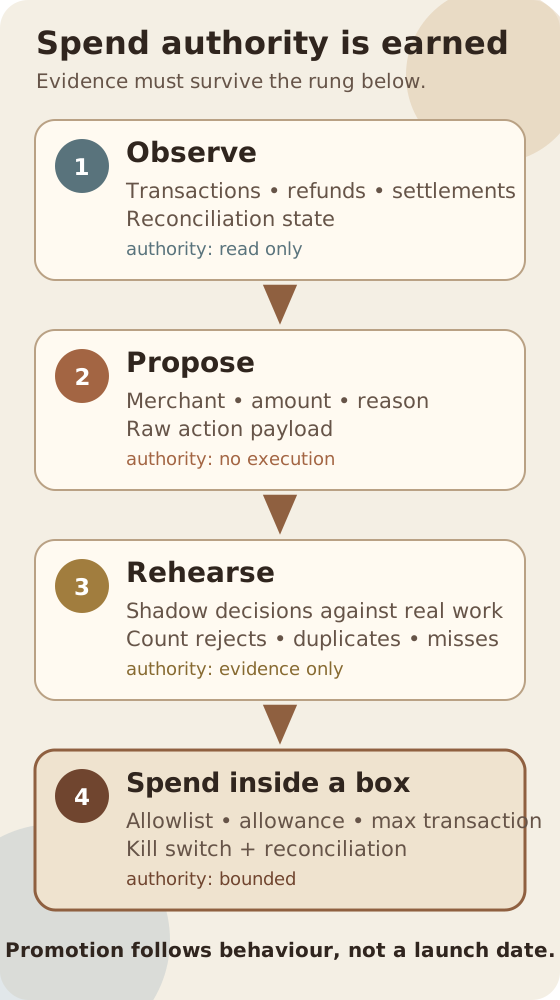
Only those observations can define a promotion decision. “It has worked for two weeks” is not enough if it made three proposals and all were trivial. I would ask for a representative event set, named failure thresholds and a clean reconciliation trail before attaching even a low-value wallet.
This is my proposed release design, not Paytm’s or Cloudflare’s published deployment method, and I have not run it against either product. The point is to turn trust into evidence you can inspect rather than a meeting where everyone feels the model has become sensible.
The same-day video gives the pattern a name
The 30-second Prompt of the Day episode produced for August 10 says every reliable agent setup reduces to state, a loop and a gate. It is broader than payments, but the mapping here is unusually clean: Paytm supplies state to read; shadow-mode comparison is the loop; wallet policy is the gate.
I checked the local 30.04-second render, its full audio transcript and ten sampled frames on September 10. The clip does not test a payment system or validate either vendor. The argument above stands without playing it; the video is the compact mental model.
Give the first wallet almost nothing
When the shadow run earns a write trial, make the first wallet deliberately boring: a short merchant allowlist, a small total allowance, a low per-transaction ceiling and an immediate stop control owned by a human. Reconcile every attempted write against the source ledger before the next one. Demote the agent to proposal-only on a duplicate, policy miss or unexplained mismatch.
The detail I would add to Cloudflare’s published controls is automatic demotion. A cap limits how much one failure can cost; demotion limits how long the system keeps failing. That turns the permissions ladder into a loop instead of a one-way graduation ceremony.
Steal this for the next finance-agent review. Do not ask, “Can the connector issue refunds yet?” Ask what the agent can observe, what it must prove in shadow mode, what tiny box it gets first and which event removes that authority. If the team cannot answer all four, the read-only connector is exactly where the deployment should stay.
Let payment agents read early, rehearse honestly and earn every write inside a box you can close.