Scientific AI needs the experiment trace
In short: Periodic Labs shows why scientific AI needs stitched experiment lineage; its internal XRD results are promising, not proof of discovery.
Periodic Labs reported on 15 September 2026 that its 1-trillion-parameter Neon model reached a 55.3% success rate on 134 difficult internal X-ray diffraction samples. The number is interesting. The operating system around it is the bigger story.
Scientific AI needs the experiment trace: the hypothesis, prediction, machine execution, failure, rerun and result. A final paper preserves the answer. It usually throws away the path that would teach a system what to try next.
Periodic Labs trains on the scientific process
At 34:14 in The Generalist interview, Liam Fedus says that “most AI has been trained on the final artifacts of science.” Periodic instead joins intentions, simulations, equipment runs and later corrections into one lineage.
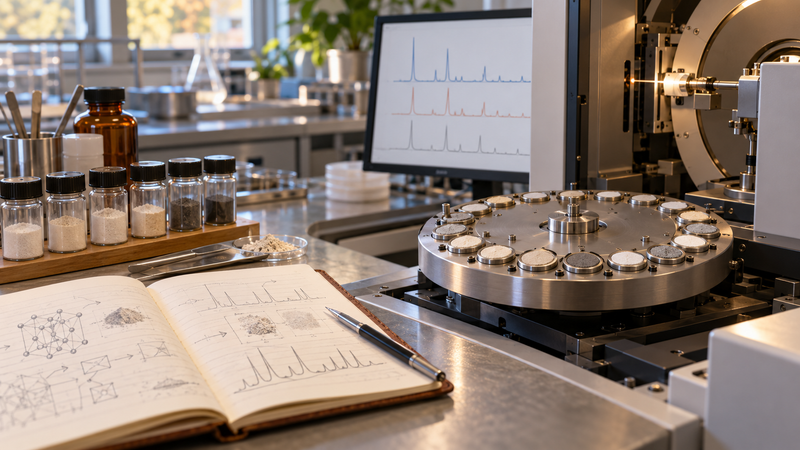
That lineage matters because physical experiments do not have software's cheap answer key. An XRD pattern can contain several overlapping phases. Periodic says the accepted solutions in its hard set contained five phases on average, and expert judgment remained part of the label.
| Periodic's reported measure | Result |
|---|---|
| FrontierXRD samples | 134 |
| Neon success rate | 55.3% |
| Initial Kimi K2.6 success rate | 2.7% |
| Human–human agreement | 77.2% |
| Judge–human agreement | 74.6% |
These are Periodic's internal results, not an independently reproduced benchmark.
The useful video moment is a lab mistake
The most useful section starts around 29:50, when the founders walk through the experiment loop. At 35:54, Dogus Cubuk describes samples that had shifted two positions in a circular holder. The labels were wrong; the model inferred the rotation and proposed the inverse correction.
That anecdote is vendor-reported, and I could not inspect the underlying run. Still, it makes the architectural point concrete: a model can only connect that error to an outcome if the system retained holder position, sample identity, instrument output and prior intent. Lose the intermediate state and the correction becomes an unrepeatable story.
At 49:23, the conversation makes the contrast explicit. Code and maths often provide fast verification and complete context. Physics does not. The strategy must handle slow experiments, partial observability and ambiguous rewards.
My practitioner judgment: preserve the trace before the answer
My labelled practitioner judgment is that enterprise agent teams should steal this data design before they copy the laboratory ambition. If an agent produces a good final decision, retain the evidence it saw, the tool state, failed branches, reviewer intervention and rerun that changed the outcome.
This is not a case for logging hidden reasoning or collecting everything forever. It is a case for governed decision lineage: explicit fields, retention limits, access controls and a replay test. The useful record is what another operator needs to reproduce the failure and evaluate the next policy.
Periodic's benchmark does not prove autonomous scientific discovery. Its evaluation is internal, its harness is proprietary, its judge uses other models, and its cost comparison depends on stated assumptions. What it does show is a more durable way to build learning data than saving only polished successes.
What's in it for you
- Add intent, tool-state, intervention and rerun fields to one agent workflow this week.
- Test whether a second operator can replay one failure without the original author's memory.
The model is replaceable; the experiment trace is the compounding asset.
Sources
- The Generalist — Can their $300M AI lab do the job of a scientist?, 29 September 2026
- The Generalist — A chatbot walks into a laboratory, 29 September 2026
- Periodic Labs — Nature Is Our Learning Environment, 15 September 2026
- Periodic Labs — AI Infrastructure at Periodic, 15 September 2026