
Performance agents need a profile-to-commit receipt
In short: Performance-agent reviews should bind the production profile, exact deployed commit, invariant tests and controlled canary in one receipt.
In a 2026 talk, Netflix engineer Rajat Shah showed a coding agent tracing one hot path to a quadratic pattern that consumed 8.8% of sampled CPU time. The agent took the investigation from profile to a reviewable code change in under five minutes.
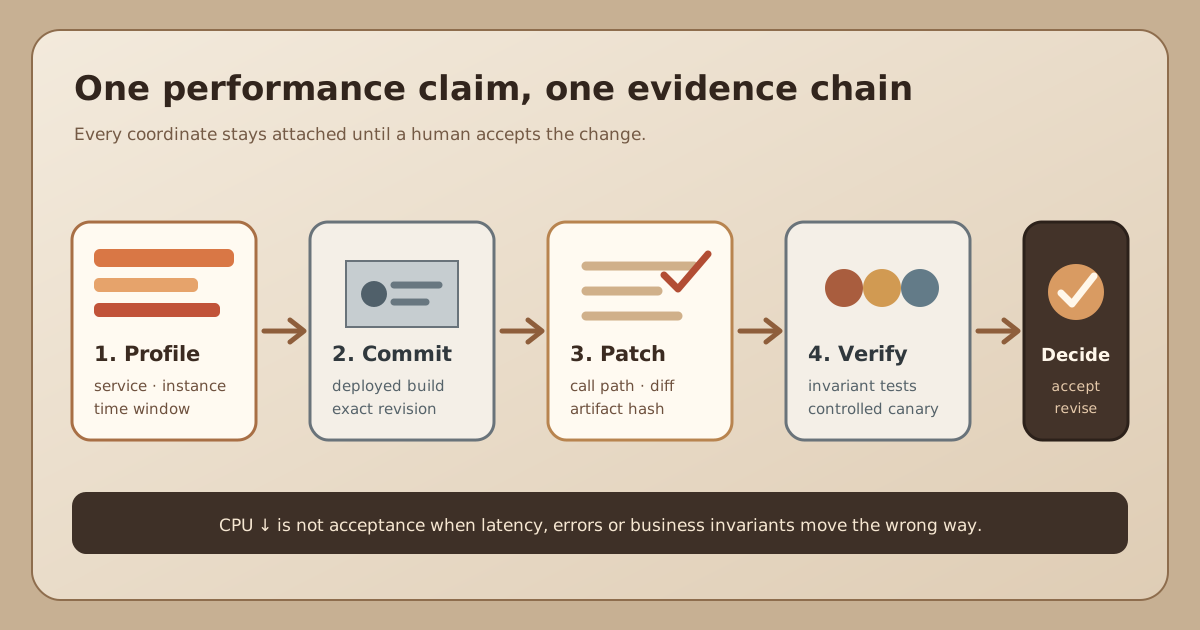
The evidence chain underneath that speed is what makes it credible. A performance agent needs a profile-to-commit receipt that binds the sampled runtime, exact deployed revision, proposed patch, invariant tests and canary delta. Until that chain is intact, a hot-path diagnosis remains a lead.
Netflix joined the profile to the code that produced it
Shah's AI Engineer World's Fair talk begins with the manual performance loop. An engineer triggers profiling, inspects call stacks, finds an expensive method, locates the relevant repository and works out a change. Shah estimated that identifying the hot path alone could take about 20 minutes.
The agent shortened that search by reading structured profiler output. In the reported example, it connected ImmutableMap.copyOf to a tensor-merge path and suspected repeated copying. That was a lead, not proof. The next step was to resolve the production build to its exact Git commit, check out that revision and trace the full call path in the source that had actually generated the profile.
This identity step is easy to lose in a demo. Main may have moved since deployment. A library may have changed. A method with the same name may behave differently in another revision. If the agent reads today's code against yesterday's profile, even a technically sound explanation can describe the wrong program.
The 8.8% figure needs the same care. Shah described the pattern's share of CPU time during the profiling period. It was not an 8.8% realised saving. The talk reports production CPU and latency improvements after optimisation, but it does not publish an outside audit or a general benchmark.
A proposed optimisation needs invariant and canary evidence
The next example turned one finding into a fleet search. Shah reported that a metrics-counter allocation pattern appeared in seven services, with a projected CPU-cycle opportunity of 0.5% to 4.6% if the pattern were fixed across them. One code shape can sit inside seven different business paths, traffic mixes and test suites, so the projected figure still needs a local test.
Netflix's proposed workflow therefore puts tests and a controlled canary before human review. Unit, integration and functional checks protect the behaviour the suite already encodes. Then an old and proposed build receive the same traffic for a bounded period, such as ten minutes. CPU and latency can improve while errors become a stop signal.
The P99 CONF session description summarises the same boundary neatly: the agent validates through canary deployment and uses measured outcomes rather than model confidence. The model proposes and connects. The profiler and canary supply observations. An engineer still decides whether the evidence is sufficient.
Ten minutes may miss a daily traffic shape. Matching error rates may hide a business-semantic change that nobody encoded. Lower CPU on one instance can move work to a dependency. The receipt should show those uncovered surfaces; “canary passed” cannot stand in for all correctness.
The review artefact I would require
For this article, I traced the conference account from the mailbox summary back to Shah's timestamped talk transcript and the P99 event page. I did not run Netflix's system, reproduce its CPU results or inspect its internal catalogue. The operating record below is my editorial proposal, not a Trigent or client deployment claim.
I would require one profile-to-commit receipt with these fields:
| Receipt field | What it prevents |
|---|---|
| Service, instance and profile window | A hot path detached from its runtime context |
| Production build and Git commit | Diagnosis against code that did not produce the profile |
| Pattern, call path and patch hash | A generic optimisation claim with no reviewable change |
| Invariant tests and versions | A faster implementation that breaks encoded behaviour |
| Canary traffic, duration and baseline | A percentage without a comparable experiment |
| CPU, latency and error deltas | Celebrating one resource win while another signal worsens |
| Uncovered invariants and human owner | Treating a passing test as complete business correctness |
The receipt expires when any load-bearing coordinate changes: deployed commit, profiler configuration, test suite, traffic slice, canary duration or acceptance threshold. A catalogue entry can preserve the lesson, but it should point back to the evidence that earned it and name where that evidence may no longer transfer.
This advances the archive's broader verifier coverage map with a performance-specific lineage. It also complements the coding-agent refinement budget: another automated cycle deserves spend only when it buys new evidence. Here, the evidence must connect a measured runtime symptom to the exact code and controlled result.
Where Netflix's evidence stops
The reported 8.8%, seven-service search, projected 0.5%–4.6% opportunity and canary workflow come from a Netflix engineer's conference talks. They are credible first-party production evidence, but I did not independently reproduce them. The public material does not report the catalogue's reuse rate, false-positive rate or savings across the full fleet.
Review-time and authoring-time use of the pattern catalogue are directions described in the talk, not measured results from the reactive pipeline. A team should begin where the evidence is strongest: observe production, bind the observation to the deployed revision, test the change and compare it under controlled traffic.
What's in it for you
- Add the deployed commit and profile window to the next performance-agent finding.
- Refuse a savings percentage without the baseline, traffic slice, duration and error delta.
- Keep the engineer's decision and uncovered invariants beside the canary result.
Let the agent propose the optimisation; let a profile-to-commit receipt prove what changed.